How Emulsion Systems Keep Cold Rolling Mills Running Smoothly
When a steel strip slides through a cold rolling mill, the invisible workhorse is often the emulsion system in cold rolling mills. This lubricating blend of water, oil, and additives does more than just reduce friction; it shapes product quality, protects machinery, and even influences energy consumption. If you’ve ever wondered why modern mills can crank out thousands of tons of sheet metal with such precision, the answer lies in the chemistry and engineering of the emulsion itself.
Understanding the Emulsion System in Cold Rolling Mills
An emulsion in this context is a carefully formulated mixture where microscopic oil droplets are dispersed in water, stabilized by surfactants. The resulting fluid is low‑viscosity enough to be pumped through high‑speed spray nozzles, yet it delivers a thin, durable film that shields roll surfaces from wear and heat. Operators typically choose between oil‑in‑water (O/W) and water‑in‑oil (W/O) bases depending on the steel grade, reduction ratio, and desired surface finish.
Key Components and Their Roles
- Base oil – Provides the primary lubricating film; mineral oils dominate, though synthetic options are gaining ground for high‑temperature stability.
- Water phase – Acts as the carrier, allowing easy heat dissipation and rapid removal of metal particles.
- Surfactants – Keep oil droplets uniformly distributed, preventing separation during storage or operation.
- Additives – Include anti‑wear agents, rust inhibitors, and pH buffers that extend roll life and maintain consistent performance.
How the System Operates on the Mill Floor
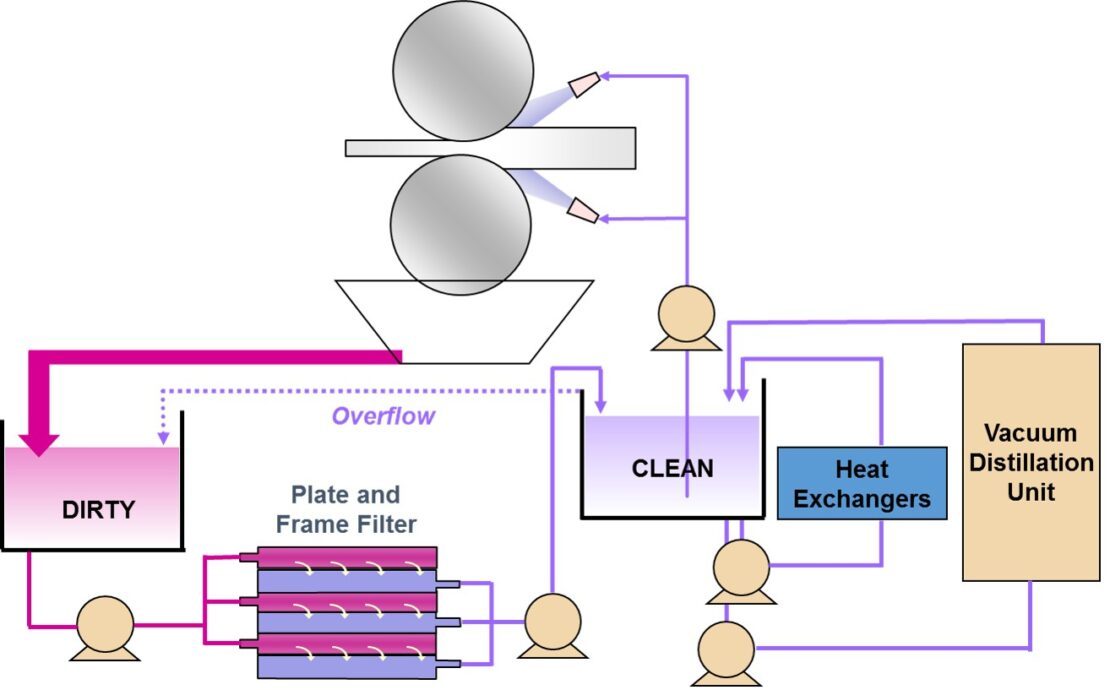
During a rolling pass, the emulsion is atomized onto the roll crown via high‑pressure nozzles. The droplets spread into a continuous lubricating film as they encounter the hot metal surface. Because the fluid evaporates quickly, it leaves behind a thin layer of oil that reduces metal‑to‑metal contact, curbs adhesive wear, and moderates the temperature rise of both strip and rolls.
Simultaneously, the water component carries away heat and any debris that might otherwise embed in the roll groove. A collection trough recovers the spent emulsion, filters out metal particles, and recirculates the cleaned fluid back to the tank, where it is topped up with fresh additives.
Benefits That Go Beyond Simple Lubrication
First and foremost, a well‑tuned emulsion system improves surface quality. By limiting direct metal contact, it reduces the likelihood of scratches, galling, or scale transfer that could otherwise lead to costly re‑work. Second, roll wear drops dramatically—studies from several mill operators suggest that roll life can extend by 30 % or more when the proper emulsion is maintained.
Energy savings are another hidden perk. With lower friction, the mill draws less motor power for the same reduction, shaving a few kilowatts per line. Finally, the environmental footprint shrinks: modern closed‑loop systems recycle up to 90 % of the fluid, cutting down on fresh oil consumption and wastewater discharge.
Routine Maintenance: Keeping the Emulsion Healthy
Even the best formulation will falter if neglect creeps in. Operators should monitor three key parameters daily: pH, oil concentration, and particle load. A pH that drifts too low can accelerate corrosion on roll bearings, while excessive oil can cause foaming and poor atomization. Particle load—usually measured in milligrams per liter—signals when the filtration system needs a clean‑out.
Typical maintenance steps include:
- Sampling the tank fluid and adjusting pH with alkaline additives.
- Checking oil content with a gravimetric or infrared method and topping up as needed.
- Back‑flushing filters and replacing cartridges on a schedule that matches production volume.
- Inspecting nozzle wear; clogged or eroded nozzles can produce uneven spray patterns, leading to surface defects.
When in doubt, a quick visual check—looking for foaming, discoloration, or oil streaks—can flag problems before they impact product.
Common Issues and How to Troubleshoot Them
One frequent complaint is “strip galling,” where the metal sticks to the roll despite lubrication. The usual culprits are low oil content or a breakdown of surfactants, both of which can be confirmed by a simple oil‑in‑water ratio test. Another symptom is “roll chatter,” a vibration that often stems from uneven film thickness; this can be traced back to clogged nozzles or inconsistent tank agitation.
If the emulsion turns milky or separates, it usually points to temperature excursions—either the tank is too warm, causing the oil to rise, or it’s too cold, leading to solidification of additives. Adjusting the tank thermostat and ensuring proper mixing speeds typically resolve the issue.
Future Trends: Smarter Emulsions for Smarter Mills
Advances in nanotechnology are bringing new additives that form ultra‑thin, self‑healing films, promising even longer roll life. Meanwhile, sensor‑driven monitoring—integrating pH probes, turbidity meters, and flow meters into a centralized control system—allows real‑time adjustments without human intervention.
Some leading mills are experimenting with bio‑based oils derived from renewable feedstocks, aiming to reduce reliance on petroleum while maintaining performance. Though still in pilot phases, early trials report comparable wear protection with a smaller carbon footprint.
Frequently Asked Questions
What distinguishes an O/W emulsion from a W/O emulsion in rolling mills?
O/W emulsions have oil droplets dispersed in water and are favored for high‑speed operations because they cool efficiently. W/O emulsions contain water droplets in oil, offering superior load‑bearing capacity for heavy reductions but can be harder to cool.
How often should the emulsion be replaced?
Replacement intervals depend on production volume and oil degradation. Many plants schedule a full tank change after processing 100,000‑200,000 tons of steel, supplemented by regular additive replenishment.
Can I use the same emulsion for hot‑ and cold‑rolling applications?
Generally no. Hot‑rolling requires emulsions that can withstand higher temperatures and more aggressive oxidation, while cold‑rolling emulsions focus on low viscosity and surface finish. Mixing the two can compromise both performance and equipment life.
Is a closed‑loop emulsion system worth the investment?
For mills with continuous operation, the savings in oil purchase, waste disposal, and environmental compliance usually offset the higher upfront cost within a few years, making it a financially sound choice for most facilities.