How IoT Powers Precision Farming: What It Stands For
When you hear “IoT in precision farming,” the image that often comes to mind is a field dotted with tiny sensors, drones buzzing overhead, and data streams flowing into a farmer’s tablet. That vision is no longer a distant sci‑fi scenario; it’s happening today. But before diving into the gadgets, it helps to answer the basics: what does IoT stand for? In short, it’s the Internet of Things—a network of physical objects equipped with connectivity that lets them collect and exchange data. In the context of agriculture, that network becomes a powerful decision‑making engine.
Understanding IoT: The Acronym Explained
IoT isn’t just a buzzword. It describes a system where everyday items—soil probes, weather stations, irrigation valves—are fitted with tiny processors and wireless modules. These devices talk to each other and to cloud platforms, turning raw measurements into actionable insights. The “Internet” part signals that the data travels over standard networks, while the “Things” are the physical devices themselves. In a farm setting, the result is a seamless feedback loop that can adjust watering, fertilizing, or pest control in real time.
Why IoT Matters in Precision Agriculture
Precision farming aims to apply inputs—water, nutrients, chemicals—only where and when they’re needed. Traditional methods rely on broad‑brush estimates, which can waste resources and hurt yields. IoT changes the equation by delivering granular, on‑the‑ground data. A farmer who knows the exact moisture level in each row can reduce irrigation by up to 30 percent, while still protecting the crop. The same principle applies to nitrogen application, disease detection, and even livestock health monitoring.
Key Technologies That Make IoT Work on the Farm
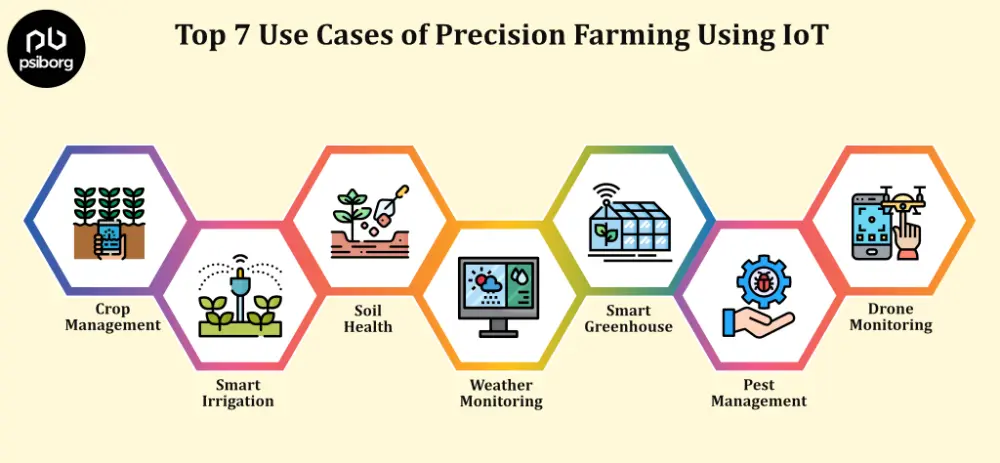
- Soil Sensors: Measure moisture, temperature, pH, and nutrient levels at depths ranging from a few centimeters to several meters.
- Connected Drones: Capture multispectral images that reveal plant stress before it’s visible to the naked eye.
- Smart Irrigation Controllers: Automatically adjust flow rates based on sensor input and weather forecasts.
- RFID & GPS Tags: Track livestock movement, feeding patterns, and health metrics in real time.
- Edge Computing Nodes: Process data locally to reduce latency, ensuring rapid responses to sudden changes.
These components don’t operate in isolation; they feed a central analytics platform that blends historical trends with current conditions. The platform then suggests—or even executes—actions, freeing the farmer from manual data collection.
Real-World Examples of IoT in Precision Farming
Consider a vineyard in California that installed a network of micro‑climate stations. By correlating temperature, humidity, and leaf wetness data, the system predicts the optimal time to apply fungicides, cutting chemical use by 25 percent and improving grape quality. In the Midwest, a corn producer uses soil‑moisture sensors linked to an automated sprinkler system. During a dry spell, the system waters only the driest sections, preserving water while maintaining uniform growth.
Livestock operations benefit too. A dairy farm equipped with neck‑bracelet sensors monitors each cow’s rumination and activity levels. Deviations trigger alerts that allow early treatment of illnesses, reducing veterinary costs and improving milk yield. These cases illustrate how IoT translates data into tangible economic and environmental gains.
Challenges and Considerations
Adopting IoT isn’t a plug‑and‑play affair. Connectivity can be a stumbling block in remote rural areas where cellular coverage is spotty. Farmers may need to invest in low‑power wide‑area networks (LPWAN) or satellite links, which adds to upfront costs. Data security is another concern; the same channels that deliver valuable insights can also expose farms to cyber threats if not properly encrypted.
There’s also a learning curve. Interpreting sensor data requires a blend of agronomy knowledge and basic data analytics. Many technology providers now bundle training and support services, but smallholders must still assess whether the return on investment justifies the effort.
Future Outlook: From Reactive to Predictive Farming
As sensor costs continue to drop and artificial‑intelligence models become more refined, IoT will shift from reacting to conditions to forecasting them. Imagine a system that predicts a pest outbreak weeks in advance, allowing preemptive biological controls. Or a network that synchronizes planting schedules across an entire region based on soil health maps generated from aggregated sensor data. Those scenarios are already in pilot stages, suggesting that the next wave of precision farming will be even more data‑driven.
Frequently Asked Questions
What are the main benefits of IoT for farmers?
IoT delivers real‑time visibility into field conditions, reduces input waste, improves yields, and can lower labor requirements by automating routine tasks.
Can small farms adopt IoT technology?
Yes. Modular sensor kits and subscription‑based platforms allow growers to start with a few critical measurements and expand as needed, keeping initial costs manageable.
How secure is the data collected by farm IoT devices?
Reputable providers encrypt data in transit and at rest, and many offer role‑based access controls. Nonetheless, farmers should follow best practices like regular firmware updates and strong password policies.
Is there a typical ROI timeline for IoT deployments?
ROI varies by crop and scale, but many growers report payback within 1‑3 years, mainly through water savings, reduced fertilizer usage, and higher marketable yields.